
Why the Frank family came to Amsterdam
Anne Frank was born in Frankfurt, Germany, but her family did not plan to stay there. As antisemitism intensified after Adolf Hitler came to power, Otto Frank moved to Amsterdam to create a more secure future for his family and to continue his work in business. Edith Frank and the two daughters, Margot and Anne, joined him afterward. Amsterdam became their new home, not because it was symbolic at the time, but because it offered practical refuge and relative normality.
That decision is the key reason Anne Frank’s house is in Amsterdam. The family lived in the city, learned its routines, and became part of local daily life. Anne attended school there, learned Dutch, made friends, and experienced the city as a real home. When persecution expanded under German occupation, the place where the family had tried to start over became the place where they had to hide.
Why the hiding place was specifically at Prinsengracht 263
The building that became the Anne Frank House was directly connected to Otto Frank’s company. He ran a business from the front part of the premises, and behind it was a concealed section of the property later known as the Secret Annex. This rear space was physically separated enough to offer a chance of hiding, especially with help from trusted employees.
That combination of factors made the address possible:
- Otto Frank knew the building well through work.
- The rear annex was shielded from the street and neighboring sightlines.
- Supportive helpers could access the site during business hours.
- The hidden rooms allowed eight people to live out of view for an extended period.
So if you have ever wondered, “Why this canal house, and not another?” the answer is largely logistical. It was not chosen as a memorial site. It became historic because it was available, hidden, connected to Otto Frank’s business, and crucial to the family’s survival for over two years.
Why Amsterdam matters to Anne Frank’s story
Amsterdam is not just the location of the museum. It is part of the story itself. Anne’s diary reflects the rhythms of wartime Amsterdam: restricted movement, fear of raids, dependence on helpers, blackouts, rationing, and the emotional tension of living hidden in a busy city. The annex was concealed, but it was never isolated from what was happening outside.
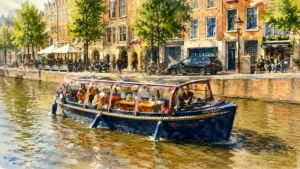
Visitors often expect only a museum experience, then realize the city context is part of what makes the visit meaningful. Walking along Prinsengracht and the surrounding Jordaan area helps explain how close the annex was to ordinary urban life. Warehouses, canals, church bells, bicycles, offices, neighbors, and street activity were all near the hiding place. That contrast between visible city life and hidden fear is central to understanding Anne Frank’s house in Amsterdam.
One practical tip: many travelers get more value from learning the neighborhood before entering the museum area. A guided walk often fills in the historical gaps that a timed museum entry alone may not fully cover.
Check Anne Frank walking tour availability
What happened to Anne Frank House after the war
After the war, Otto Frank, the only one of the eight people in hiding who survived, returned to Amsterdam. Anne’s diary survived because it had been preserved by Miep Gies and Bep Voskuijl, two of the helpers who assisted the group in hiding. As Anne’s writing reached readers around the world, the building at Prinsengracht 263 became internationally significant.
Over time, there was growing recognition that the annex should be preserved. The Anne Frank House museum was later established so people could learn not only about Anne and her diary, but also about antisemitism, persecution, war, human rights, and the dangers of discrimination. In other words, the building remained in Amsterdam because that is where the original history happened, and preserving the real place gives the story weight that a reconstruction elsewhere never could.
What you see today versus what was there then
Some visitors are surprised by how restrained the museum feels. The rooms in the annex are intentionally not fully refurnished. Otto Frank wanted the emptiness to remain, partly to show the loss left by deportation and war. That absence can be more affecting than a heavily staged historical display.
| Then | Now |
|---|---|
| Working warehouse and office at Prinsengracht 263 | Museum and remembrance site |
| Secret Annex hidden behind movable bookcase | Preserved historic space visitors can see |
| Place of concealment during Nazi occupation | Place of education about the Holocaust |
| Known only to a small circle of helpers and occupants | Known globally through Anne’s diary |
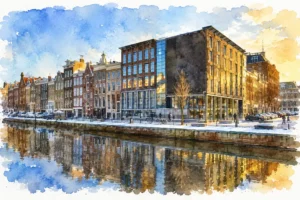
That helps answer a second version of the original question: Anne Frank’s house is in Amsterdam because the actual building is still there, and the city preserved it as the authentic site of her wartime hiding place.
How to understand the location before you visit
If you are planning a trip, it helps to separate three things:
- The family’s life in Amsterdam — schools, neighborhood life, adaptation after leaving Germany.
- The annex as a hiding place — the physical rooms behind the business premises.
- The museum experience today — timed entry, queues, interpretation, and visitor rules.
Many people arrive assuming the Anne Frank House is simply a preserved home. It was not their ordinary family residence. It was the hiding place connected to Otto Frank’s company building. That distinction matters and clears up common confusion.
Another practical detail: tickets to the Anne Frank House itself are often in high demand. Travelers who cannot get museum entry still choose a nearby historical walking tour to understand the story in place, which can be a very worthwhile backup rather than a lesser substitute.
See small-group tour details here
Real visitor perspective: what stands out most
Based on common traveler feedback and on-the-ground expectations, three reactions come up again and again.
1. “The city context changed the experience for me”
Several visitors say that reading Anne Frank’s diary and then standing in the canal district makes the history feel more concrete. One traveler described the strongest moment not as entering the museum, but as realizing how normal and beautiful the street looked compared with the fear hidden behind the facade. That contrast stayed with them long after the visit.
2. “I wish I had learned the background first”
A frequent review point is that prior context helps a lot. People who joined a walking tour or read up in advance often felt more grounded. They understood who the helpers were, how the annex functioned during the day, and why silence mattered. Without that context, some visitors felt the museum moved quickly and left them wanting more explanation.
3. “It is emotionally heavy, but not sensationalized”
A reassuring thing many people note is that the site is handled with restraint. It is not designed like a dramatic attraction. That makes it more trustworthy. Visitors often appreciate the sober presentation and the emphasis on historical understanding over spectacle.
Is the Anne Frank House actually a house?
Yes and no. In everyday language, people call it Anne Frank’s house because that is the recognized museum name and the address associated with her story. But technically, the famous part is the Secret Annex within the rear section of Otto Frank’s business premises. So the term “house” is correct in common usage, yet not quite the same as saying it was a typical family home where Anne lived openly.
This matters for expectations. The site is more compact, more architectural, and more historically layered than many first-time visitors imagine.
Best ways to visit with enough context
If your goal is understanding rather than simply checking off a landmark, this general order works well:
- Start with a guided neighborhood walk or historical overview.
- Learn the broader wartime history of Amsterdam and the Frank family.
- Then visit the museum area or the canal district around Prinsengracht.
- Allow quiet time afterward; it is not usually a rushed attraction.
That approach is especially helpful for first-time visitors, families with older children, and travelers who want more than a short museum stop.
View current walking tour options
Key facts at a glance
| Question | Short answer |
|---|---|
| Why is Anne Frank’s house in Amsterdam? | Because the Frank family moved there from Germany, and the hiding place was in Otto Frank’s Amsterdam business building. |
| Was it the family’s normal home? | No, the famous site is the Secret Annex where they hid, not simply their regular residence. |
| Why that specific address? | It had a concealed rear annex connected to Otto Frank’s workplace and trusted helpers. |
| Why is the building preserved today? | It is the authentic site where Anne wrote her diary while in hiding. |
FAQs
1. Why did Anne Frank live in Amsterdam instead of Germany?
Her family left Germany because conditions for Jewish families became increasingly dangerous after the rise of the Nazi regime. Otto Frank moved to Amsterdam first to establish work and create a safer situation for the family. Amsterdam represented refuge and stability at the time, even though that safety was later destroyed by German occupation.
2. Was Anne Frank born in Amsterdam?
No. Anne Frank was born in Frankfurt, Germany. She later moved to Amsterdam as a child. That is why people sometimes confuse her nationality, identity, and place of residence. Her most famous writing, however, is deeply connected to Amsterdam because that is where she wrote her diary while in hiding.
3. Is Anne Frank House the same as the Secret Annex?
In practice, people often use the names interchangeably, but they are not exactly identical. The Anne Frank House is the museum and historic site at Prinsengracht 263. The Secret Annex refers specifically to the hidden rear section where Anne, her family, and four others stayed concealed. The annex is the heart of the visit.
4. Why didn’t the Frank family hide somewhere else?
The annex at Otto Frank’s business premises offered a rare combination of access, concealment, and support. The location was familiar, and trusted office helpers could bring food, news, and supplies. Finding another place with those conditions would have been extremely difficult during occupation, especially under anti-Jewish restrictions and constant risk.
5. What makes Amsterdam important in Anne Frank’s story today?
Amsterdam is the physical setting of Anne’s wartime experience. The streets, canals, and old warehouse district help explain how hidden life existed within an active city. Visiting the neighborhood gives essential context, showing that the annex was not isolated in the countryside but embedded in everyday urban life.
6. Can you visit the exact rooms where Anne Frank hid?
Yes, the museum includes the historic annex rooms. Visitors should know that the spaces are preserved in a stripped-back way rather than heavily reconstructed. That can be surprising, but many people find the emptiness powerful because it reflects the impact of deportation and loss more honestly than a staged interior might.
7. Is it worth doing a walking tour if I cannot get museum tickets?
For many travelers, yes. A strong walking tour can explain the Frank family’s move to Amsterdam, the German occupation, the neighborhood around Prinsengracht, and the broader Jewish history of the city. It is not the same as entering the annex, but it can still be deeply informative and often helps you understand the site better.
8. Did Anne Frank actually write her diary in that building?
Yes. Anne wrote much of her diary while hiding in the Secret Annex in Amsterdam. That fact is one of the main reasons the building is so significant. It is not just associated with her memory in a general way; it is the real place where she recorded her thoughts, fears, hopes, and observations.
9. Why is the museum so famous worldwide?
The museum is globally known because Anne Frank’s diary became one of the most widely read personal accounts of the Holocaust. The building gives that testimony a real physical setting. People do not only come to see old rooms; they come to connect a universally known text to the place where it was written.
10. How much time should I allow for this part of Amsterdam?
If you want more than a quick stop, allow at least half a day. The museum area, the canal district, and a guided walk or independent historical route deserve time. Many visitors benefit from slowing down, since the emotional and historical significance of the area is not something most people want to rush through.
Helpful planning reads
If you are organizing your visit, these guides can help you compare options and avoid common planning mistakes:
- Anne Frank House Amsterdam tickets guide
- Is Anne Frank House Amsterdam worth visiting?
- Anne Frank walking tour in Amsterdam overview
Sources and further reading
For primary educational context and character background, these are the most reliable places to continue reading:
For broader trip planning, start here: Anne Frank walking tour Amsterdam hub.