
Munich Old Town Walking Tour: Best Sights, Route & What You’ll See
A Munich Old Town walking tour is one of the most practical ways to see the city’s historic center in a few hours. Most routes start around Marienplatz and continue to sights such as the New Town Hall, Frauenkirche, Old Town Hall, Viktualienmarkt, Peterskirche and the former royal avenues. A typical guided walk lasts about 2 to 3 hours, although the exact route, duration, meeting point and language depend on the booking you choose.
Expect to walk roughly 2 to 4 kilometers on mostly paved streets. The historic center is generally easy to explore on foot, but comfortable shoes are important because you may stand on cobblestones and pause outdoors. Tour prices, departure times and availability change by date and group size, so check the current booking page before paying. For the most comfortable experience, book an earlier time slot, allow extra time to reach the meeting point, and keep the rest of the day flexible for museums, markets or cafés.
- Best for: first-time visitors, couples, families with older children and travelers who want historical context.
- Main starting area: usually Marienplatz or another central Old Town meeting point stated on the ticket.
- What is normally included: a local guide and a guided exterior visit to major landmarks; entrance tickets are often separate.
- What to bring: comfortable walking shoes, weather protection, water and your booking confirmation.
Powered by GetYourGuide
Munich Old Town walking tour FAQ
This guide focuses on what you are likely to see, how to plan the route and what to check before booking. Individual tours differ, so use the activity listing as the final source for the exact meeting point, language, inclusions and cancellation terms.
1. What does a Munich Old Town walking tour usually include?
A standard Old Town walk introduces the central landmarks rather than trying to cover every museum or neighborhood in Munich. The route commonly begins at Marienplatz, the city’s main historic square, where guides explain the New Town Hall, its ornate façade and the Glockenspiel performances scheduled on selected days. From there, the walk may continue past the Old Town Hall, St. Peter’s Church, Frauenkirche and nearby streets connected with Munich’s medieval and royal history.
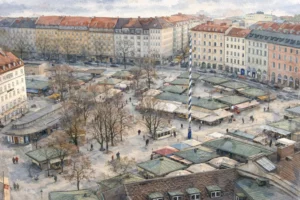
Many tours also include a stop at Viktualienmarkt, although the amount of time spent there depends on the route and the market’s opening conditions. A guide can explain how the market developed, point out local specialties and suggest places for a later snack. Most sightseeing is from the outside. If you want to enter a church, tower or museum, ask whether admission is included or plan a separate visit.
The main value is context. Instead of seeing a sequence of attractive buildings without a story, you learn how the city center was shaped by the Wittelsbach rulers, Catholic traditions, war damage and postwar reconstruction. Check the description carefully if you specifically want food tastings, museum entry, hotel pickup or a private guide, because these are not automatically included.
Check current Munich walking tour availability
2. Which sights are on the usual Munich Old Town route?
The exact order varies, but a well-planned central route usually connects the following places without requiring public transport:
| Sight | What you may learn or see | Practical note |
|---|---|---|
| Marienplatz | The historic central square, the Marian Column and views of both town halls | Often busy, especially around the Glockenspiel performance |
| New Town Hall | Gothic Revival architecture, civic history and the famous clock figures | Outdoor viewing is usually part of a walking tour |
| Old Town Hall | A historic municipal building with a distinctive tower and ceremonial rooms | Interior access depends on opening times and the tour plan |
| Frauenkirche | Munich’s twin-towered cathedral and an important city symbol | Dress and visitor rules may apply during services |
| St. Peter’s Church | One of Munich’s oldest churches and a major viewpoint if the tower is open | Additional admission and many stairs may apply for the tower |
| Viktualienmarkt | Food stalls, seasonal produce, beer garden traditions and local market life | Some stalls may close on Sundays or public holidays |
| Odeonsplatz and royal avenues | Monumental architecture and links to Munich’s royal and political history | Often included on longer routes rather than short introductions |
A tour may also pass through narrow lanes around the old city gates, Residenzplatz or the pedestrian shopping streets. Do not assume that every listed landmark receives the same amount of time. If one place matters most to you, ask the guide at the beginning whether there will be a pause for photographs or a later return visit.
3. Where does the tour start, and how should you reach the meeting point?
Marienplatz is the most common reference point for Old Town sightseeing, but the actual meeting place can be beside a named statue, building entrance, hotel or public square. The ticket should show the precise location. Read the instructions rather than relying only on the general tour title, particularly if several operators meet in the same area.
Munich’s central railway station, Hauptbahnhof, is connected with the Old Town by the S-Bahn and U-Bahn network, and Marienplatz is also served by several underground and suburban rail lines. Walking from the station is possible, but it takes longer than many visitors expect once you allow for crowds and luggage. Arrive 10 to 15 minutes early so you can find the guide without rushing.
Use an official transport app or station information on the day because engineering works, demonstrations, events and platform changes can affect the fastest route. If you are staying outside the center, allow additional time for a transfer. A taxi or rideshare may not be able to stop directly beside the meeting point in pedestrian areas.
View available dates and meeting details
4. How long does the walking tour take, and how difficult is it?
Most central introductory tours take around 2 to 3 hours. A shorter route can concentrate on Marienplatz and the nearby churches, while a longer walk may extend toward the Residenz, Odeonsplatz or additional royal landmarks. The distance is usually manageable for ordinary walkers, but the experience can feel tiring because you spend much of the time standing while listening.
The route is generally flat and paved, yet the surface can include cobblestones, uneven edges and crowded pedestrian streets. Wheelchair and stroller access varies by route and by the interior spaces visited. Contact the operator before booking if you need step-free access, regular seating breaks or a route that avoids stairs. A guide may be able to adjust the pace, but this should not be assumed for a shared group tour.
Families should consider the attention span of younger children. A private tour can make it easier to add short breaks, while a small-group walk may work well for older children who enjoy stories about kings, city legends and architecture. Bring water in warm weather and make a plan for an indoor break if rain is forecast.
5. What is the best time of day to take a Munich Old Town tour?
Morning tours are often the easiest choice for visitors who want quieter photographs and cooler temperatures in summer. They also leave the afternoon free for the Residenz, museums, shopping or a market visit. Midday routes can be lively and convenient, but Marienplatz and Viktualienmarkt may be crowded, especially during peak travel periods.
Late-afternoon walks can provide softer light and a natural transition to dinner, although winter daylight ends early. If you want to hear or see the New Town Hall Glockenspiel, verify the performance schedule and whether your selected departure overlaps with it. The clock’s operation is not a guarantee that every tour will stop at exactly the right moment.
Opening hours are particularly important for churches, markets, towers and museums. A walking tour can normally continue in light rain, but heavy weather may change the route or make outdoor commentary less comfortable. Check the forecast, wear layers and confirm the operator’s policy if severe weather is expected.
See current tour times and ticket options
6. How much does a Munich Old Town walking tour cost?
There is no single fixed price for all Munich Old Town walks. The cost depends on whether the experience is shared or private, the group size, the guide’s language, the duration and whether admissions or tastings are included. Prices can also change between weekdays, weekends and high-season dates.
Compare the total price with the inclusions rather than choosing only by the headline amount. A lower-cost walking tour may cover exterior sights and exclude church towers, museum entry, food, transport and gratuities. A private tour generally costs more overall but can offer a slower pace, a customized route and more opportunity for questions.
Review the booking page for the currency, taxes, payment timing, cancellation deadline, minimum group size and child policy. If the listing says that entry tickets are not included, budget separately for any attraction you plan to visit afterward. Keep confirmation details accessible on your phone and check whether the operator requires a printed voucher.
7. What should visitors bring and wear?
Comfortable shoes are the most important item. The historic center is compact, but a tour involves continuous walking, standing and occasional changes in pavement. Wear layers that can be adjusted rather than relying on one heavy jacket. A compact raincoat or umbrella is useful because much of the commentary takes place outdoors.
- Bring water, especially from late spring through early autumn.
- Carry a small bag rather than bulky luggage, which is awkward in crowded squares.
- Use sun protection on bright days because several stops are exposed.
- Keep your booking confirmation and meeting instructions available offline.
- Bring a small amount of cash if you plan to buy a market snack, while remembering that payment methods vary by stall.
Churches are active places of worship, not only sightseeing stops. Wear respectful clothing and follow requests about photography, silence and access during services. If you plan to climb a tower afterward, check the stairs and admission arrangements before committing to a tight schedule.
8. Is the tour suitable for families, older travelers and visitors with limited mobility?
For many families and older travelers, a central walking tour is a good introduction because the sights are close together and the route can be explained without changing transport. The main challenge is not the distance but the time spent on your feet and the busy public spaces. Ask about seating opportunities, restroom access and the number of participants before booking.
Visitors using wheelchairs, walkers or strollers should request specific accessibility information. Some streets are level and pedestrianized, but historic entrances, church thresholds, underground passages and tower routes may include steps. A tour described as “easy” does not necessarily mean fully step-free. Share your requirements with the operator in advance and ask whether a companion can remain with the group if a particular interior stop is inaccessible.
For children, short explanations tied to visible details work better than a long lecture. Consider booking a private experience if your group needs frequent breaks or wants to spend more time at one landmark. Otherwise, choose a departure that does not conflict with nap times or a major meal.
9. What are the main advantages and limitations of a guided walk?
A guide helps you understand relationships that are easy to miss when exploring alone. You may learn why the town halls face Marienplatz, how Munich’s churches reflect the city’s religious history, what reconstruction changed after the Second World War and how royal power influenced the streets around the Residenz. A local guide can also point out practical details such as public toilets, quieter photo angles and reliable places to return for food.
The limitation is that a group tour follows a timetable. You may have only a few minutes for photographs, and the guide cannot always pause whenever someone wants to enter a shop or church. Commentary quality also depends on the individual guide and group size. Read recent booking feedback for comments about pace, clarity, language and meeting-point organization rather than focusing only on star ratings.
These comments illustrate why the best choice depends on your priorities. A visitor seeking a broad orientation may prefer a shared tour, while someone interested in architecture, religious history or photography may benefit from a private or specialist route.
10. How should you plan the rest of the day after the tour?
Do not schedule a distant attraction immediately after the walk. Allow at least 30 to 45 minutes for the tour to finish, finding a restroom, taking photographs and reaching your next stop. If the route ends near Marienplatz, you can continue to Viktualienmarkt for lunch, return to a church when it is open or walk toward the Residenz and Odeonsplatz.
Market hours, church services and museum entry slots can change, so check them separately. A guided walk is often most useful at the start of a Munich stay because it helps you recognize the layout and decide where to return. Travelers who want a more focused experience can follow it with a food-focused visit to the market, an evening historical walk or a specialist tour of an architectural interior.
For more planning ideas and related routes, see the Munich travel hub. It can help you combine the Old Town with other attractions without packing too many activities into one day.
Check ticket availability before your visit
Quick booking checklist
- Confirm the exact meeting point and arrival time.
- Check the duration, language and maximum group size.
- Find out whether admissions, food, transport or gratuities are included.
- Review accessibility information and the cancellation policy.
- Save the confirmation offline and wear suitable shoes for several hours outdoors.