
Franz Kafka Museum Prague: Tickets, Prices & What to See
Is the Franz Kafka Museum in Prague worth visiting? If you enjoy literature, atmospheric exhibitions or the stranger side of Prague’s history, it is one of the city’s most distinctive small museums. Rather than telling Kafka’s life story through labels alone, it uses original documents, shadowy installations, projections and music to explore the relationship between the writer and the city where he grew up.
It isn’t an enormous museum, a reconstruction of Kafka’s apartment or a conventional collection of his possessions. Its exhibition is deliberately dark and symbolic, reflecting the anxiety, alienation and ambiguity that run through works such as The Trial and The Metamorphosis. That makes it fascinating for some visitors and less rewarding for others.
Located in Malá Strana, a short walk from Charles Bridge, the museum is easy to fit into a Prague itinerary. If you already know you want to go, compare Franz Kafka Museum admission dates; if you’re deciding whether it deserves an hour or more of your trip, read on for the exhibits, ticket choices and practical details.
Franz Kafka Museum at a glance
| Visitor question | Quick answer |
|---|---|
| Where is it? | Cihelná 2b, Malá Strana, Prague 1, near Charles Bridge |
| Opening hours | Daily 10:00–18:00, subject to special closures |
| Adult admission | 300 CZK, official published price |
| Reduced admission | 220 CZK for children, students and seniors 65+ |
| Family admission | 800 CZK for two adults and two children |
| How long to allow? | About 60–90 minutes as a flexible planning estimate |
| Main appeal | Literary manuscripts, personal letters, Prague history and atmospheric installations |
Our advice: Choose this museum for the mood and the way it interprets Kafka’s writing—not because you expect a large chronological biography. If you have never read Kafka, the exhibition can still be interesting, but reading a short introduction to his life first helps.
Compare admission options
For a standard visit, you need admission to the permanent exhibition. You can buy directly from the museum, or compare the available dates below. The bookable entry option covers museum admission and access to the exhibition; it is not a guided walk through the galleries. Prices and cancellation terms may differ between providers, so check the final total before choosing.
Powered by GetYourGuide
What is the Franz Kafka Museum really about?
Kafka was born in Prague in 1883, when the city belonged to the Austro-Hungarian Empire, and wrote in German while living within a multilingual, culturally complex city. His stories often describe individuals facing an intimidating authority, a confusing set of rules or a world they cannot fully understand. Prague’s streets and institutions helped form his imagination, even when his fiction does not identify specific real-life locations.
The museum takes this connection as its starting point. Instead of simply listing where Kafka lived, worked and studied, it asks how the real city might have become the bewildering imaginary landscapes of his novels. This approach explains why the rooms can feel more like an art installation than a traditional writer’s house.
What will you see inside the museum?
Original writings, letters and historical objects
The permanent exhibition contains first editions of Kafka’s works, correspondence, diaries, photographs and drawings. These objects place his reputation as an international literary figure alongside details of an often difficult personal life. Even visitors who have read only The Metamorphosis can recognize the value of seeing the documents and historic imagery together.
One of the pleasures of this collection is noticing the everyday Prague around Kafka: family photographs, streets, buildings and personal relationships that existed long before his writing became a symbol of the modern world. The museum connects biographical material with the emotional tensions in his fiction rather than asking visitors to memorize a sequence of dates.
Existential Space: Kafka in Prague
The first major exhibition section, Existential Space, explores how Kafka’s life in Prague influenced his imagination. Materials from his diaries and letters introduce his relationships, fears, working life and position within the city. This is the more biographical half of the visit, though it is still presented in a dramatic, interpretive manner.
Visitors who already know his books may appreciate the parallels between Kafka’s thoughts about authority, family, work and identity and the characters in his stories. Those who are new to the writer can use this part to understand why his fictional worlds feel so unsettling.
Imaginary Topography: Prague in Kafka
The second section, Imaginary Topography, turns the question around. It considers how Kafka transformed real places into symbolic spaces. In his novels and stories, streets and buildings often matter less as identifiable Prague addresses than as metaphors for confusion, isolation or power.
Photographs, documents, reconstructed elements and audiovisual sequences build a particular atmosphere. Prague City Tourism describes five audiovisual programmes and music created for the exhibition. Expect shadow, sound and theatrical presentation—not just brightly lit display cases full of book covers.
The courtyard artwork before or after your visit
The courtyard outside the museum also has an eye-catching artwork by Czech sculptor David Černý: two bronze figures standing in a shallow basin shaped like the Czech Republic. It is irreverent and unusual, a sharp contrast to the reflective mood inside the galleries. You can see the courtyard without confusing it with an exhibition in the museum itself.
This is not the famous rotating metal head of Kafka near the Quadrio shopping centre. That kinetic sculpture is in a different part of central Prague. If you are following Kafka-related landmarks, both can make sense on the same day, but they require separate stops.
Franz Kafka Museum tickets and current prices
The museum’s official admissions page lists an adult ticket at 300 CZK, reduced admission at 220 CZK for children, students and seniors aged 65 or older, and a family ticket at 800 CZK for two adults and two children. These are published rates checked during this article’s preparation, not guaranteed prices for every future travel date.
For ordinary visitors, entry to the long-term exhibition is the main purchase. The museum separately offers a private professional guided visit for 1,000 CZK on top of admission, booked at least seven days in advance. That private booking is different from simply buying an entry ticket, and the museum says it does not offer regular non-private group guided tours.
It is worth comparing the final price in Czech crowns when buying directly with any other ticket option. Third-party booking services can be convenient, but an admission ticket should not automatically be described as skip-the-line, as an audio-guide package or as a guided visit unless the specific booking expressly includes those benefits.
For a flexible, independently paced visit, check available Kafka Museum entry tickets and the current cancellation conditions. If you want the museum’s private guide, contact the museum itself in advance rather than assuming that service is part of standard admission.
How long should you spend at the Kafka Museum?
The museum does not advertise one universal visit duration. For planning, allow roughly one to one and a half hours, particularly if you read captions and give the audiovisual sections time. A visitor already familiar with Kafka may choose to linger over letters and documents; someone primarily interested in the visual atmosphere may move through more quickly.
Rather than scheduling the museum between two tightly timed bookings, leave a little flexibility. The building is close to Charles Bridge, so it combines naturally with a walk along the river or into the Lesser Town without requiring a special cross-city journey.
Is it worth visiting if you haven’t read Kafka?
Yes, but it helps to approach the experience with the right expectation. You do not need to have finished The Trial to enjoy the museum’s images, music and unusual staging. The broader themes—uncertainty, alienation, authority and an individual trying to understand society—are recognizable without specialist literary knowledge.
Still, the museum is much richer for people who have read something by Kafka or are curious about the historical Prague in which he wrote. If you mainly want colorful interactive activities or something playful for young children, another attraction may be a better fit. A small literary museum with dim lighting is not interchangeable with an illusion museum or hands-on science exhibition.
Where is the Kafka Museum and how do you get there?
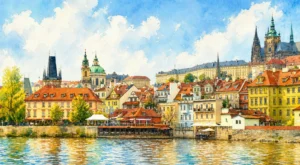
The museum is at Hergetova cihelna, Cihelná 2b, 118 00 Prague 1, on the Malá Strana bank of the Vltava. It is just north of the western end of Charles Bridge, so the easiest way for many visitors is to walk from the bridge through the Lesser Town streets toward the riverside courtyard.
If you are arriving by public transport, Malostranská on Metro line A is a useful reference point, with tram connections nearby. Check current tram and metro service before leaving, especially during temporary roadworks. Allow extra time to find the courtyard entrance rather than searching for a large modern museum building visible from across the street.
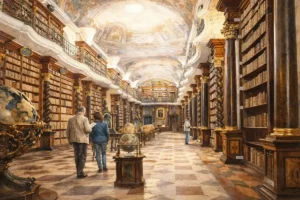
For a city-centre route, you can pair the museum with Charles Bridge, the riverbank and the Klementinum across the river. Our Klementinum visitor guide covers the Baroque Library and Astronomical Tower, which is a separate ticketed experience.
Kafka Museum versus the World of Franz Kafka: what’s the difference?
Prague also has a more recent attraction called World of Franz Kafka, at Náměstí Franze Kafky 1 near Old Town Square. It is not the same venue as the Franz Kafka Museum in Malá Strana. This difference matters when following maps, buying tickets or meeting other people at the entrance.
The traditional Franz Kafka Museum focuses on the writer’s documents, his life and the city’s transformation into the imaginative geography of his works. World of Franz Kafka uses immersive video, unusual spaces and contemporary installations to explore Kafka-inspired themes in a different way. The two can complement each other, but buying admission to one does not entitle you to enter the other.
If your main interest is authentic letters, first editions and the author’s connection to his home city, start with the Franz Kafka Museum. If immersive contemporary visuals are your priority, compare the other exhibition’s current programme and ticket conditions before deciding.
Where is the rotating Head of Franz Kafka sculpture?
The kinetic metal Head of Franz Kafka is located by the Quadrio shopping centre at Národní třída, south of Old Town Square. It is an outdoor artwork, not an exhibit inside either Kafka venue. Many visitors understandably confuse its location with the museum because both are commonly photographed in Prague travel guides.
Seeing the sculpture is free from the public area, while entering the Franz Kafka Museum requires a ticket. A good Kafka-themed day might include the museum, a wander through the streets of Old Town where the writer lived, and the kinetic head sculpture—but only if those stops genuinely interest you.
Opening hours, accessibility and practical tips
The museum publishes daily opening from 10:00 to 18:00. Special events, holidays or operational changes can alter access, so consult the official museum website shortly before your visit.
The exhibition uses subdued lighting and sound, which contributes to its mood but may not suit visitors who are sensitive to dark environments or audiovisual effects. The museum’s online visitor information does not clearly establish every accessibility arrangement; visitors requiring step-free access, seating or other assistance should contact the museum directly at office@kafkamuseum.cz before purchasing.
Check the museum’s current photography rules at the entrance instead of assuming flash photography is permitted. An ordinary admission does not include a personal guide, souvenir book or printed map, but the museum sells a separate Franz Kafka’s Prague map for 60 CZK and an exhibition guidebook for 120 CZK, subject to availability and current prices.
Should you visit the museum on a rainy day?
This is a particularly good museum to keep as a flexible indoor option when Prague’s weather turns cold or wet. You can enjoy the exhibition, then continue to nearby cafés or attractions without leaving central Prague. It is also a sensible stop if your trip is short and you want something culturally distinctive that does not require an entire morning.
For a full Prague sightseeing day, think of the museum as one stop rather than the sole destination. You can combine the Lesser Town streets with Charles Bridge and later cross the river for Old Town. Our Visit Prague guide can help you connect these sights without unnecessary backtracking.
Frequently asked questions
Is the Franz Kafka Museum worth the money?
It is a rewarding choice if you appreciate Kafka’s work, twentieth-century literary history or atmospheric exhibition design. The experience may feel short or abstract if you expect a huge museum or a conventional room-by-room biography, so match the ticket to your interests.
Do you need to book in advance?
Advance booking can be useful when you want a specific travel date or are visiting during a busy period, though the museum also provides official ticket sales. A private professionally guided museum visit must be requested at least seven days ahead.
Is it the same as World of Franz Kafka?
No. The Franz Kafka Museum is at Cihelná 2b in Malá Strana; World of Franz Kafka is at Náměstí Franze Kafky 1 in Old Town. They are separate exhibitions with separate tickets.
Does an admission ticket include a guided tour?
No. Standard admission provides access to the exhibition. The museum’s private professional tour is an additional service with advance booking and a separate fee.
How close is the museum to Charles Bridge?
It is a short walk from the Lesser Town end of Charles Bridge, in the historic brickworks complex beside the river. You do not need to travel to the Old Town Square or Quadrio shopping centre to find the museum.
Can you see the rotating Kafka Head sculpture here?
No. The rotating metal head is a separate outdoor attraction near the Quadrio shopping centre. Outside the museum, you can instead find the distinctive courtyard fountain by David Černý.
Our verdict: who should choose the Franz Kafka Museum?
Go if you want to discover the mind of a famous Prague writer through documents, art and atmosphere. The museum offers a distinctive cultural experience within walking distance of Charles Bridge. Skip it if you primarily want an interactive family attraction, a big general-history museum or an exhibition centered on the rotating Kafka Head sculpture.
For a straightforward independent visit, compare entry ticket options for your Prague dates and confirm the final price and terms. If you’re still building the wider itinerary, browse our Prague travel hub for nearby cultural attractions and practical sightseeing ideas.