
Is an Old Quebec Walking Tour Worth It?
An Old Quebec walking tour is worth it for a first visit when you want history, orientation and efficient routing in one experience. The standard Grand Walking Tour lasts about two to two and a half hours and connects major parts of Upper and Lower Town while a live guide explains what you are seeing.
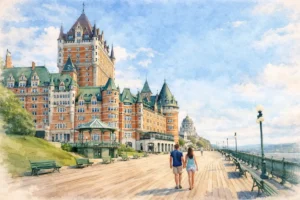
Typical areas include Dufferin Terrace, City Hall, the Seminary, fortifications, Place Royale and Quartier Petit-Champlain. You could reach many of these places independently, but the guide adds historical context and helps you understand how the city developed rather than treating each landmark as an isolated stop.
For most first-time visitors, a guided walk is a strong investment because it makes later independent sightseeing easier. You finish with a mental map, a clearer sense of the city’s history and a list of places worth revisiting at your own pace.
Powered by GetYourGuide
Is an Old Quebec walking tour worth it for a first visit?
Yes, especially if you have limited time and want to understand the historic district rather than simply photograph it. A guide can connect major landmarks, explain the relationship between Upper and Lower Town and point out details that are easy to miss.
The value is strongest early in your stay because the tour helps shape the rest of your sightseeing.
Check the Old Quebec Grand Walking Tour
What does a guide add beyond exploring independently?
A guide adds interpretation. Old Quebec has many old buildings, walls and public spaces, but without context it can be difficult to know which details are historically important.
A well-designed route also reduces unnecessary backtracking on hills and cobblestones, which matters more than it may seem after several hours of sightseeing.
If you are deciding whether a guide is necessary at all, see whether you need a guided tour of Old Quebec.
What a guided Old Quebec walk adds:
- A clear route through major Upper and Lower Town areas.
- Historical context for buildings, fortifications and public spaces.
- Less time spent researching or backtracking on your own.
- A useful mental map for the rest of your stay.
The main tradeoff is less flexibility for long photo stops, shopping or spontaneous detours.
Which parts of Upper and Lower Town can you cover?
A standard tour can connect major Upper Town areas around Dufferin Terrace and City Hall with Lower Town areas such as Place Royale and Quartier Petit-Champlain.
This gives you a practical understanding of the city’s elevation changes and how the historic districts fit together.
The exact route can vary, so treat the listed stops as representative rather than guaranteed in a fixed order.
See current route and language options
Who gets the most value from a guided Old Quebec walk?
First-time visitors, history enthusiasts and travelers with only one or two days benefit most. The guide compresses research and orientation into a manageable block of time.
Solo travelers can also enjoy the social structure, while couples and families may appreciate not having to navigate and research every stop independently.
Travelers who already know the city or strongly prefer unstructured wandering may get less value.
What are the limitations of the standard walking-tour format?
You follow a group pace and fixed route, so there is less freedom to stop for extended photography, shopping or food. The tour also takes place on historic streets with hills, cobblestones and uneven surfaces.
Current activity information notes that the standard route is not suitable for wheelchair users or travelers with significant mobility limitations.
Weather matters as well because tours generally operate outdoors in varied conditions.
Should you choose a private or group tour?
A group tour usually gives the best value for a general first introduction. A private tour is better if you want customized history, a flexible pace or more time for questions.
Families, multigenerational groups and travelers with specific interests may justify the extra cost of a private guide.
For a detailed comparison, see private versus group walking tours in Quebec City.
How should a walking tour fit into the rest of your Quebec City trip?
Take it early, then revisit the areas you liked most. A two- to two-and-a-half-hour guided walk leaves plenty of time for museums, cafés, a river cruise or independent wandering.
If you are choosing a duration, see how long an Old Quebec walking tour should be.
For official destination information about guided walks, consult the Quebec City tourism guide to walking tours.
Timing the tour early in your stay increases its value. If you take it on your final afternoon, the guide may point out places you would love to revisit but no longer have time to see. On the first day, those same discoveries become useful recommendations for the rest of the trip.
Weather and pace also matter. In rain or cold, two hours of outdoor walking can feel longer than expected, while a pleasant day can make the same route feel easy. Bring layers and water, and avoid arriving already exhausted from several hours of walking. The guided tour should help you understand Old Quebec, not become the point at which your feet give up.