
Is a Historical Walking Tour of Quebec City Worth It?
A historical walking tour of Quebec City is worth it when you want the streets, fortifications and buildings of Old Quebec to make sense as one story instead of simply moving from landmark to landmark. This history-focused walk lasts about two hours and is led by a guide in colonial-period costume, using the historic district itself to explain roughly four centuries of people, conflicts, political change and daily life.
The main value is interpretation. Old Quebec is compact enough to explore independently, but many details are easy to miss without context: why the city was fortified, how the upper and lower districts developed, which buildings changed function over time, and how French and British periods shaped what you see today. Because the experience takes place outdoors on real historic streets, expect hills, stairs, cobblestones and uneven surfaces.
For travelers who enjoy history, this is a strong way to start a Quebec City visit. The costumed presentation makes the material memorable without replacing the historical substance, and the two-hour length is long enough to build a coherent picture of Old Quebec while still leaving time to explore independently afterward.
Powered by GetYourGuide
What makes a historical walking tour of Quebec City worth doing?
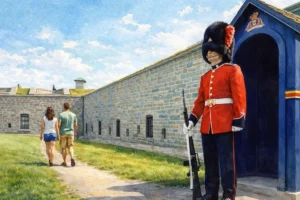
The biggest advantage is context. Old Quebec is visually impressive even if you know nothing about its past, but a guided historical walk helps explain why the district looks the way it does. Defensive walls, narrow streets, prominent religious buildings and the division between Upper and Lower Town are easier to understand when they are connected to the city’s political and military history.
A good historical guide also helps separate important details from background scenery. Instead of treating every old building as equally significant, the tour can explain which locations played a role in major events, how ordinary residents lived, and how the city changed over several centuries.
This is especially useful early in a trip. After the tour, you are likely to recognize references and places that appear again in museums, at the Citadelle or while walking independently.
Check the Old Quebec historical walking tour
What does a two-hour Old Quebec historical walk cover?
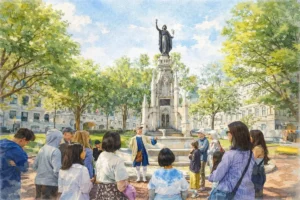
The experience uses the historic district as an open-air classroom rather than concentrating on one museum. Over about two hours, the guide moves through streets and public spaces while linking them to the wider story of Quebec City. The emphasis is not simply on taking photos of landmarks but on understanding the people, conflicts and decisions that shaped the city.
The exact walking route can vary by session, so it is better to think in terms of themes than a guaranteed checklist of stops. Expect discussion of colonial Quebec, the strategic importance of the St. Lawrence River, fortifications, changing political control and the way Old Quebec developed as a lived-in urban district.
Because the tour moves continuously, it is more efficient than trying to research every site independently while you walk. You can then return later to the locations that interested you most.
How does a costumed guide change the experience?
The colonial-period costume gives the tour a stronger sense of place. It creates a visual connection with the historical setting and makes the storytelling feel more immediate, particularly for travelers who find conventional lecture-style tours dry.
The costume does not mean the experience has to feel like a fictional performance. The value still comes from accurate interpretation, but the guide can present historical episodes in a more vivid way by speaking about events where they happened and helping you imagine the city in a different period.
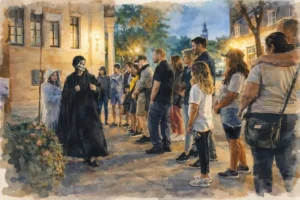
This format can also work well for older children and teenagers who may engage more easily with a character-led presentation than with long museum panels. Travelers who prefer a darker, more theatrical subject can compare it with the Crimes of New France walking tour.
See current historical tour details
Who gets the most value from a history-focused walking tour?
The clearest fit is a traveler who wants to understand Old Quebec rather than simply see it. People interested in Canadian history, colonial history, architecture, military strategy and urban development are likely to get the most from the experience.
It is also useful for first-time visitors who feel overwhelmed by the number of historic buildings in the old city. A guided walk gives you a framework, after which independent sightseeing becomes easier because you know which streets or sites deserve more time.
The tour may be less valuable if your main goals are shopping, food stops or unstructured photography. In that case, an independent walk may give you more freedom. If you are deciding whether any general guided walk is necessary, see whether an Old Quebec walking tour is worth it.
How is this different from a general Old Quebec walking tour?
A general Old Quebec tour normally balances several goals: orientation, major landmarks, practical city context and some history. A history-focused tour puts more weight on interpretation and chronology. That means you may hear more about why places matter and less about restaurants, shopping streets or general travel tips.
The difference is subtle but important. If this is your only guided activity and you mainly want to know where everything is, a broader tour may suit you better. If you already have your bearings or genuinely enjoy historical storytelling, the specialized format usually offers more depth.
For a closer look at the kind of historical material that can appear on broader walks, read what history you can learn on an Old Quebec walking tour.
What physical conditions should you expect on the route?
Old Quebec’s historic character also creates practical challenges. Expect hills, stairs, cobblestones and uneven pavement. Comfortable closed or supportive walking shoes are a better choice than footwear designed only for appearance.
The tour takes place outdoors, so weather matters. In warm conditions, bring water and sun protection; in cooler or wet weather, layers and a rainproof outer layer make the experience much more comfortable. Historic streets can also feel more slippery when wet.
Current activity information does not describe this as a wheelchair-suitable experience. Travelers with significant mobility limitations should verify current access before booking rather than assuming the route can be modified at every point.
How should you fit a historical walking tour into an Old Quebec day?
The most efficient strategy is to take the tour early in your Old Quebec sightseeing, then use the rest of the day to revisit places that caught your attention. Because the tour lasts about two hours, it can fit comfortably before lunch or in the afternoon without taking over the entire day.
Avoid scheduling another timed activity immediately after it. Hills, group pace and the exact finishing location can make the end time feel less predictable than a museum visit. Leaving a buffer also gives you time for photos or to continue exploring rather than rushing away.
For broader planning, the Quebec City tourism guide can help connect Old Quebec with other city experiences. For official destination information about the city’s historical and heritage attractions, consult the Quebec City tourism history and heritage guide.